The often deranged postings of yet another hacker, pretending to be an Astronomer, pretending to be a hacker who has written a book or two for O'Reilly Media.
Update: The official release date seems to be the 3rd of November, but there are still unconfirmed rumours that the device is already shipping, although perhaps not in large quantities?
I have a bluetooth keyboard and a bluetooth mouse, why do I have a wire running from my computer to my monitor? Well to be fair, I don't as I've got an iMac, but that isn't really the point. Supposing I didn't, and supposing I wanted to connect to my monitor without a pesky wire running between my computer and the monitor.
Teq Gear's WID101 (via Gizmodo) is the first product that almost gets me what I want. Plug it into your monitor, and then you can stream your video data to the monitor, either over a wired network, or crucially, over an 802.11g wireless network. That means if you've got a wireless keyboard and mouse, your computer can actually be in a whole other room to you while you're typing away.
Why? Well think about hanging a 30-inch Cinema Display on your wall, with your Mac mini safely tucked away out of sight. A bluetooth keyboard and mouse, and you're all sorted.
Problems? Well yes, overlooking the fact that the mini can't drive a 30-inch monitor, the WID101 is as ugly as sin, and not that much smaller than the Mac mini itself. You're better hanging the mini off the back of your monitor and having it in plain sight than using the WID101.
Oh, and it only works under Windows, there isn't any support for Mac OS X, or Linux for that matter. Presumably Teq Gear uses some Windows only software to take your video output, crunch it down, encrypt it, and stream it over your network interface to the WID101.
The real pain with remote storage is the slow speed, it looks like these guys have solved that, at a price.
When you buy a zBox you're not really buying the hardware you're renting it. What you actually take out is a service plan based on how many GB you need to backup, and what you get for your money is a local NAS device which also acts as a staging area for the remote backup to Amazon's S3 service. Because the offsite mirror of your backup is done hourly by the NAS device, rather than your own computer, the slow speed of remote storage presumably isn't really going to be a problem. Especially since if you want access to your files you can pull them from the local copy on the NAS, rather than having to wait for, and with S3 pay for, access to your remote storage. However since you now have two additional copies of your data, one on the local NAS, and one remote on the S3 service, you've got decent redundancy.
An interesting feature is that the NAS box they provide with the service is self-monitoring, and if the device notices the beginnings of a hardware failure, it will notify Zettabyte Storage, who will send you a replacement unit. With a bit of luck the replacement unit might even arrive before your old one fails.
Of course all this comes at quite a hefty price, around US$49 (plus tax?) per month for 32GB of redundant storage. However the price, obviously, will vary with how much you want to store. Their top of the line offering being 740GB for US$299 (plus tax?) per month.
As an aside, one thing I really, really, hate about the Zettabyte site is that they're obviously purists, they're stating their storage in binary GB, rather than the artificially inflated size used by hard-disk manufacturers. That battle was lost a long time ago, and what their doing is only going to confuse people. It certainly confused me, I had to pull up a calculator to figure out exactly what they were talking about.
However for a certain market segment, this is a killer device, and it provides a unique service. I'm just not sure how big that market segment is considering the price of the service plans?
This is a really odd thing for Apple to come out with, something like this is designed for the road warrior, and the core demographics of the people buying the current 15 and 17-inch models aren't road warriors, they're the power users. I'm confused here...?
It's been obvious for a while that to keep up with the other manufacturers Apple would have to release a new MacBook Pro with an Intel Core 2 Duo inside. Well, today was the day, and we got our new models.
The only surprising thing here is the timing. Traditionally Apple has held off big announcements until the Macworld conference in January, an not worried about a pre-Christmas release like many retailers. So either this is viewed as a minor update, not worth mentioning, or the Leopard has changed its spots. No pun intended...
Along with some friends and in the dim and distant past, around 15 years ago now when I was still an undergraduate, and the web hadn't been invented yet, I ran an LP Mud. It turned out that LPC, the language that you used to create content inside the MUD, was a fairly powerful object-orientated programming language, which did in fact later evolve into a "serious" language called Pike.
It's possible that I wouldn't be doing what I do today if it hadn't been for writing thousands of lines of LPC, it taught me the fundamentals of object-orientated programming in a far more visual way than is normal. If you can "see" the objects being created in front of you, the object-oriented metaphor isn't really a metaphor anymore.
Around the same time, although I didn't read it for years afterwards, Neal Stephenson wrote a book called Snow Crash which established him as one of the better serious science fiction authors of his generation. Unlike many books of the cyberpunk genre, Snow Crash is packed full of dark humour, and satire, and amongst its hideously complicated interweaving plot lines the book discussed how a virtual reality-based Internet, the Metaverse, might evolve in the near future.
When I finally got around to reading Snow Crash about five or six years after Stephenson wrote it, I couldn't help nodding my head. His Metaverse was very similar to what my friends and I had sketched out as the the next step forward for online collaboration. However the hardware and the bandwidth of the time made such a thing virtually impossible, and instead we got the web. But we still wanted the Metaverse, and interim hacks like VRML started to emerge. But as anyone that played around with VRML at the height of its popularity in the late nineties can tell you, the hardware and the bandwidth still weren't there yet.
Second Life has been getting a lot of press recently as their user numbers soared past the one million mark. When I first head about Second Life I was interested, but it sounded like yet another game. It looked like the twenty first century equivalent of the MUD I played around with in the twilight years of the twentieth. I was wrong, its so much more powerful than that, they've gone and invented the Metaverse while I wasn't looking.
The beauty of what Linden Labs have done is to build and elegant suite of tools to allow content to be created easily. The tools are intuitive, and can be picked up by most people fairly easily, and you don't have to be a programmer or a graphics designer to use them. They're simple enough for inexperienced users to build quite complicated in-game structures, but powerful enough so that a professional graphics designer (almost) wouldn't complain about the features they offer.
If you are a programmer then the in-game scripting language, LSL, is going to be fairly trivial to pick up as it appears to be a bastardised off-spring of C, Perl and Javascript. However the real power is that the language allows you to establish an XML-RPC server as part of an in-game object that is accessible from outside Second Life, and also allows objects to call external HTTP services; basic GET and POST services, but also XML-RPC and even SOAP services from inside the game. Second Life isn't a game, it's a platform.
Big companies have been remarkably quick to pick up on the new platform; you might have seen the stories as Reuters opened an online bureau in Second Life. They aren't alone, in recent months companies such as Sun, IBM, Wired, Adidas, Reebok have all established presences in the Second Life world.
The secret is that the back end data stored at Linden Labs isn't going to change. If, or when, we finally see the back of our traditional flat screen and keyboard interface, then all that has to change is the client side application. The world itself is perfectly adapted for immersive virtual reality. In fact I'd be very surprised to learn that there wasn't someone at Linden working on that sort of things, stereoscopic head mounted displays and force feedback gloves fit perfectly into the paradigm used by Second Life. It's even possible that it might (finally) drive widespread adoption of this sort of technology.
Of course flat files aren't dead, nor are they really dying. After all they're what's underneath everything;
Hiro is messing around in Flatland...his reason for being in Flatland is that Hiro Protagonist, the last of the freelance hackers, is hacking. And when hackers are hacking they don't mess around with the superficial world of the Metaverse and avatars. They descend below the surface layer and into the netherworld of code and tangled nam-shubs that supports it, where everything you see in the Metaverse, no matter how lifelike and beautiful and three-dimensional, reduces to a simple text file - Neal Stephenson in Snow Crash
As a profession, programmers aren't a dying breed either, no matter what some of the media coverage might have us think. But we are going to have to change, we're going to have to work much more closely with graphic designers, or specialise in the low level code that's behind the scenes from the avatar in the street.
Of course we're there already, have you ever seen a GUI designed by a team of programmers without significant input from the potential users, or a decent designer? Programmers produce notoriously bad user interfaces, and awful documentation. With or without the Metaverse we're eventually going to have to fix that, but the arrival of a platform where our code has to look as good, as well as work correctly, is going to speed things up a bit.
We might not have to worry about the Metaverse proper for a decade or more, but this is where things are going. It might not be Second Life, but it's going to be someone, and it's going to be soon. I'd advise anyone that intends to make a career in programming to take a look and come visit me when you do. This, whether we like it, or not is going to be the future. The users like it that way...
Second Life: The Official Guide by Michael Rymaszewski, Wagner James Au, Mark Wallace, Catherine Winters, Cory Ondrejka & Benjamin Batstone-Cunningham ISBN 047009608X, paperback, £12.60
After a taxi, three airports, two flights, two trains, another taxi, and 23 hours of travelling later, I'm back in Exeter...
Warning: Your browser does not support Javascript, and it therefore can 't load the ADASS tag cloud. Are you reading this in an RSS reader? Try clicking through to the website.
I must admit to being incredibly slack about blogging ADASS this year, I used to do a talk by talk account of most of the conferences I went to, about the only one I do that for now is OSCON, when I'm lucky enough to get to go that is...
Of course other people aren't being so slack, although Brad, notorious for being slack about such things, is pretty much in the same position as me having only blogged the day before the conference. Perhaps understandably enough, he's been more interested in earthquakes since.
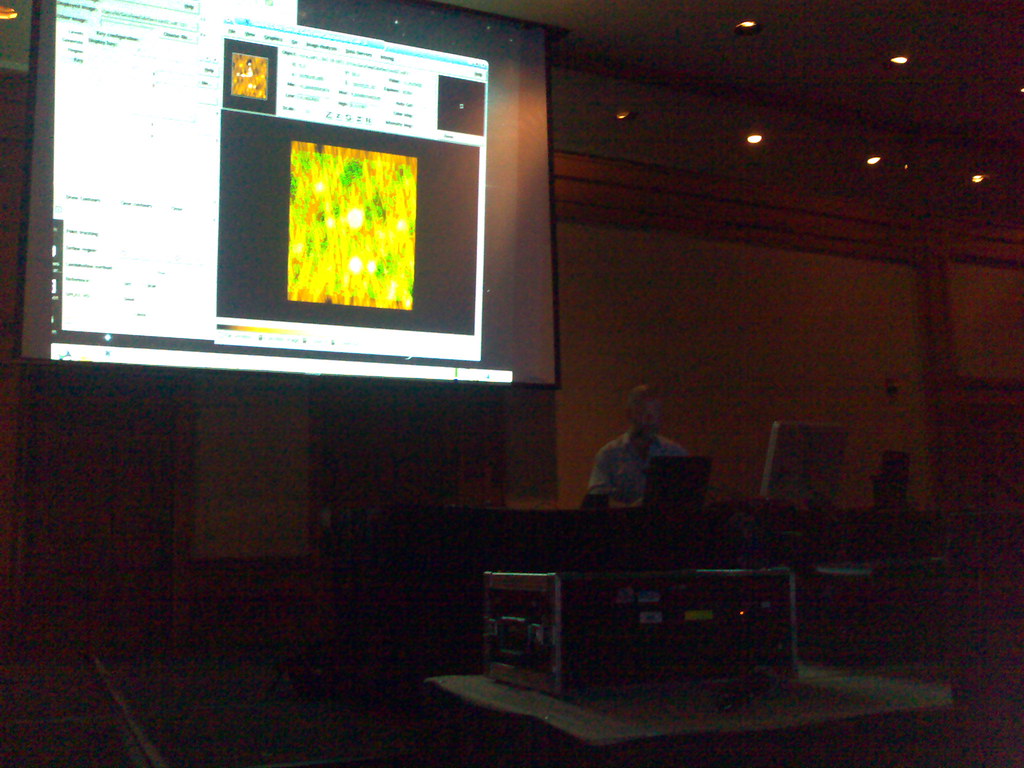
Overall I think ADASS this year has been a good meeting, there has been some good stuff presented, for instance Andrew Connolly presented the work he's been doing while on sabbatical with Google Pittsburgh. Michelle Borkin talked about using medical imaging software to display astronomy data. We have our own medical physics group at Exeter so I think I'll be talking to them on my return to see if they have any experience with the programs she was discussing.
I've also got a lot of work done, and had a bunch of corridor meetings, and it's amazing how much you can get done with those things. I've even finished writing some code. Which can't be bad. I was getting very depressed about he quality of work presented at ADASS, but it looks like my year away from the conference has been worthwhile. Either everyone has picked up their game, or I've returned with renewed enthusiasm. You can't complain...
I'm at ADASS right now, so I'm not paying as much attention to my news feed as normal, but it was hard to miss yet more iPhone rumours. I'm no longer going to make any sort of prediction about whether the iPhone really exists, or whether it's ever going to actually ship. We've been talking about this for two years now, enough already...
I stayed up last night and wrote some talks, two in fact, both of which I gave today. Unfortunately staying up late meant that the cold I'd been successfully holding off for a week or so finally managed to take a firm hold, and my immune system collapsed under the onslaught. So I'm now having a cold instead of holding one off...
There was a large contingent there for today's demo by Peter Draper of GAIA 3D, and its support for the Plastic protocol, was very heartening. For those of us who were at the last Starlink focus session at the NAM in 2004, where the project offered free beer, and still didn't draw much of a crowd for the session, renewed interest in what is pretty much a best of breed bit of technology is good to see...
Update: In hindsight I guess the cold was my own fault, if I'd just recycled an old talk then I could have gone to bed a lot early. Actually adding new material in was where I went wrong...
Update: Finally managed to get out of LAX at ten past eight at night, about two and a quarter hours later than planned. Which put me into Tucson too late to do anything useful, but still too early to go directly to bed, despite it being around seven o'clock in the morning in the time zone I woke up in when I started the day.
I can't tell, it doesn't work in Apple's Safari. I'm not changing browsers just to get some random online application working. Even if it does come from Google...
The rumours about a widescreen iPod have been circulating all year, and after a brief hiatus after the special event last month where we saw the iPod, iPod nano and iPod shuffle all updated, the rumours are back. This time Engadget is spreading the rumour that Apple is about to announce a wireless video iPod.
The rumour makes sense, and the timing with respect to the holiday season and the launch of Microsoft's Zune would be perfect. Especially if the iPod's wireless support isn't crippled in the same way Microsoft has done to the Zune, a move which has attracted a huge amount of criticism.
Today Nick Carr posted about Mike Arrington and about the possible conflicts of interest between bloggers, the companies they blog about, and their assumed responsibilities to their readers.
For the A-list bloggers, people who are normally up to their necks in the Valley, and might have power to guarantee success or failure for a start-up, much as the old time theatre critics could do to a Broadway show, it's a thorny problem. We all know that Robert Scoble worked for Microsoft, and now works for PodTech.net, other aren't so transparent. But then, surely that's only to be expected?
I think Nick is missing the point, these days we all expect biases in our media coverage, after all, only Fox News is fair and balanced..? I wouldn't take Mike Arrington's opinion as gospel, no more than I'd take Nick Carr's, or for that matter any blogger. The secret is very much in the sauce, read lots of view points and filter out the biased ones. Or not, read only people that agree with you. The choice, surely, is your own?
In the spirit of transparency however; I run adverts from Google AdSense and am a member of both the UK and US Amazon affiliate programmes. I also a member of the TradeDoubler affiliate programme, and links to the UK Apple Store will go via that programme.
I don't make a lot of money off any of this, in fact I don't think Amazon has ever paid me a red cent, and I would honestly say that it doesn't affect what I write in the slightest. But what if thousands, or even tens of thousands, of pounds of click-throughs rested on a positive review of a product? Or people were handing me free demonstration models of the latest technology, or I'd just sunk my life savings into yet another Web 2.0 bubble start-up. Would I be biased? Heck yes, although I'd try hard to take a neutral point of view and acknowledge those biases. You should always take everything with a pinch of salt, even me...
...the single most important piece of context information is this: You're holding a telephone.
Most people don't know how to use their phone, and even if they do know how to use it, they mostly use it to make calls and (in the UK and Europe at least) send text messages. Nobody cares about MMS or, the holy grail of the 3G operators, video calling, and after the horribly broken first implementation, they don't care about WAP either.
I'm one of the few people I know, and I know a lot of alpha geeks, that use mobile data seriously. Do you know how I find interesting new mobile sites? I use my laptop. Most of the stuff turned up by the current generation of search tools is either trying desperately to sell me something, or is desperately broken.
If you want me to see and use your mobile site, put a prominent link on your normal website. Please don't use auto-detection as the sole method of figuring out that I'm coming from a phone or PDA, it mostly doesn't work. For instance my Nokia N80 advertises itself as "Safari" since it uses a Webkit based browser, and I'm not going to risk running up my data bill by loading your normal webpage on the off chance that you'll figure out I'm on a phone and send me a light weight version.
So yes, I need a decent mobile search, but not very often. I'm also not entirely sure if everyone else needs it or not, what's your target market here? Are you looking for the early adopters and alpha geeks, or the man in the street? If the later I think you're in for an uphill struggle, they don't even think they need mobile data yet, to them they're still holding a telephone, and considering what's out there I don't blame them.
Mobile search isn't the killer application for mobile data, there is very little out there to search yet, except an unending stream of sites selling ring tones. Build the killer app, and then figure out how to index it...
Update: I'm obviously poking the holy cow with a stick here because I've had a sack full of email today about this, so lets make one thing clear, I still think that the next big thing will be mobile computing. The desktop paradigm we all live with today is dead, but mobile search? That isn't the next big thing, it might be next big thing three or four iterations down the line, but first we need some content.
Well the rumours have been circulating for days that Google and YouTube were in talks, and for once rumours were actually true. The deal has just been confirmed (via TechCrunch), with Google buying YouTube for US$1.65 billion in an all stock transaction, apparently winning out over Yahoo in a bidding war that almost went to the wire...
The acquisition raises a lot of questions, and you have to wonder how tightly the YouTube is going to get tied into the Google infrastructure. After all, they already have their own Video hosting service. Will YouTube be Google's Flickr and mange to maintain it's own identity, even under the newly extended corporate wing..?
Update: Robert Scoble makes a good point about the deal,
Another angle? Google is getting over its initial engineering-driven arrogance. You know the kind. Where when you show engineers... something like YouTube they answer "we can build that in a few weeks."
I heard that over and over again at Microsoft and my friends at Google say it a lot too. It's called "not invented here" syndrome. The fact that someone told the Google Video folks to sit down and be quiet during this deal is pretty significant. - Robert Scoble
Not invented here syndrome is endemic to the software world, far more than hardware, because after all lets face it, sometimes it's true. But most times people saying this are missing the subtleties, the many minor problems and off the wall solutions the guy that got there first had to go through to get his software working well. Just because you didn't invent it first, doesn't mean you should go out and re-invent it, not unless you're really sure that it's as easy as it looks.
The corollary? With Google Video already rolled out, and as feature packed as YouTube itself, maybe Google found that they could re-invent the wheel, but couldn't bring the community that had built up around the YouTube to it..?
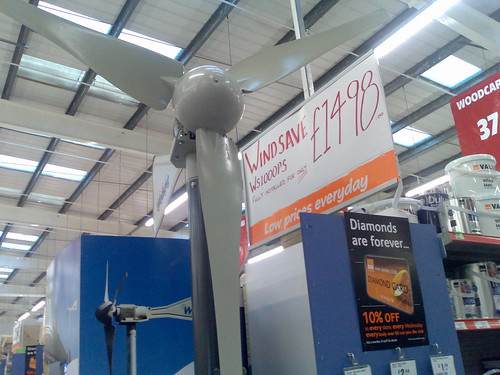
I was picking up some bits and pieces at my local branch of B&Q, for my American readers, think Home Depot, which is buried in the isolated heartland of rural Devon so I was fairly surprised to run across a wind turbine and a solar panel on display in the store.
I've talked about dropping off-grid and distributed microgeneration before, but this shows how mainstream these ideas are becoming, and gives me a little bit of hope that maybe we aren't done for after all.
So AppleInsider is spreading the rumour (via CrunchGear) that Apple have already slowed production of the current generation of Core Duo MacBook Pros in preparation for an early rollout of updated models with the the Core 2 Duo. In fact, they've said that production of the new model has already begun. Which would be nice, if true. But considering the track record of the rumour sites over the last year or so, I'll believe it when I see it...
It looks like eBuyer is now accepting PayPal. This normally wouldn't be a cause for celebration, but it turns out at least one person will be happy. My wife has ended up, through various nefarious activities, with around £80 in a PayPal account.
She was understandably nervous about linking her PayPal account to a bank account, but at the same time didn't want to buy any pointless junk off eBay. So now we're sorted, she can buy gadgets instead. Good result I think, and I'll leave it for you to decide which one of us this has made happy...
This image from the High Resolution Imaging Science Experiment on NASA's Mars Reconnaissance Orbiter shows the Mars Exploration Rover Opportunity near the rim of "Victoria Crater." Victoria is an impact crater about 800 meters (half a mile) in diameter at Meridiani Planum near the equator of Mars. Opportunity has been operating on Mars since January, 2004. Five days before this image was taken, Opportunity arrived at the rim of Victoria, after a drive of more than 9 kilometers (over 5 miles). It then drove to the position where it is seen in this image.
Shown in the image are "Duck Bay," the eroded segment of the crater rim where Opportunity first arrived at the crater; "Cabo Frio," a sharp promontory to the south of Duck Bay; and "Cape Verde," another promontory to the north. When viewed at the highest resolution, this image shows the rover itself, wheel tracks in the soil behind it, and the rover's shadow, including the shadow of the camera mast. After this image was taken, Opportunity moved to the very tip of Cape Verde to perform more imaging of the interior of the crater.
But I'm far less interested in Amnesty Generator than in their other application, Amnesty Singles. This is a drag-and-drop utility that converts any Dashboard widget into a standalone application that'll run on Panther as well as Mac OS X Tiger. That's great news for me as I can take my widgets, convert them into stand alone applications, and hand them to my colleagues who haven't yet got around to upgrading to Tiger yet...
I immediately downloaded the test version, looks like shipping the widgets internally to the generated OSX bundle file is only available to registered users. No problems, I'm quite willing to pay the registration fee for something this useful, it's only $9.95. Then I saw the catch, can you?
See the catch?
Note: Applications with bundled widgets can only run on computers where Amnesty Singles is registered in your name.
That's a daft restriction, it's not even a requirement that other people who are using your application have their own version of Singles, it has to be your own copy. What I want to be able to do is give other people my application, and I'm not even adverse to paying a higher licensing fee to have this capability. However it doesn't look like Mesa Dynamics want you to be able to do that, and I'm not really sure why?
It looks to me to be a case of DRM gone mad. They've obviously got some cool technology going on under the hood, and they're scared that someone wants to copy it. My advise to them, don't be so scared.
Most companies can't find their backside with both hands, and most wouldn't recognise a good idea if it hit them between the eyes. Don't cripple your application or service because you're afraid people will steal it, it'll just make them annoyed enough so that they'll give up and walk away...
Update: I got a response from Mesa Dynamics which I've reprinted, with permission, below;
Amnesty Singles is a consumer-targeted application (not a developer targeted one) and so it is meant for typical users to run widgets as standalone applications (as opposed to creating a re-distributable application to publish).
One of our biggest worries in developing Singles was that by allowing bundling of widgets into a newly built Singles application, some users would be tempted to "wrap" someone else's widget and pawn the new application off as their own creation. This would in fact be copyright infringement, and since our application would be the conduit of such infringement, we could be liable if someone wanted to bring a lawsuit. Clearly, this security risk (for us) would still exist even if we restricted launches to registered users of Singles.
When it comes to running a business, being wise about risk management is key. We cannot afford to deal with possible infringement lawsuits, and thus we had to come up with a solution that would make redistribution of bundled widgets to a third-party impossible.
Our solution (besides restricting it altogether) was to allow registered users to run their creations on any machine that had a Singles license registered to them.
So, it really isn't a DRM issue to "protect" our technology. It's a risk avoidance strategy, which in this day in age, is the reality of the software business.
Now, to get back to your point: we are going to introduce a free Developer program for Amnesty technologies later this fall / early winter. Widget developers who register will receive free licenses to all Amnesty applications and will be able to use Singles to create re-distributable applications. By using this strategy, we can insure that widget authors are the only ones creating applications from their own creations. - Danny Espinoza, Mesa Dynamics
Which, you have to admit, makes a lot of sense. I'm glad to see that they've got a developer programme in the works, and really glad to see it's going to be free, although quite frankly the application is so useful I'd be quite happy to pay for it. Thanks for the quick response guys...
It probably means that Apple is planning some sort of mashup with Google Maps inside iPhoto itself, which will possibly allow you to geotag, and then presumably display, your now georeferenced images.
If only it hadn't been Yahoo that bought Flickr, my image sharing service of choice...
So today Nokia unveiled its Wibree standard, which in all honesty looks to be a head on competitor to Bluetooth, no matter how Nokia are tying to spin things. For a company that has amongst the best Bluetooth support in the industry, this came as a bit of a surprise, and certainly has a lot of people confused.
I think they're facing an uphill struggle if they want us to dump our Bluetooth PANs and move wholesale to to the new standard. Virtually every bit of gear I own now has Bluetooth in one form of another, the installation base they're facing is huge, so Wibree will have to offer huge advantages or be able to coexist alongside the existing Bluetooth devices, somehow!
It's a gutsy move on their part, and it's definitely not game over at this stage, but game on...
It looks like Google have things kicking around that they consider such a radical change that they can't even drop them onto Google Labs. It appears that Google is now running an alternative search engine, which they've named searchmash (via Inside Google).
While the Google web applications use a lot of AJAX it hasn't really penetrated that heavily onto their front page. This is possibly because they'd have to rip their interface down to the ground and build it around AJAX concepts to do things properly, and with searchmash, that's exactly what they've done.
The interface is clean, simple and fast and you can see where the AJAX components, like the ability to reorder the search results, could feedback into the page rank algorithm and benefit everyone.
Google just got the jump on everyone again, although no doubt they're cursing whoever leaked the existence of the new interface this early.
That said, a CSS overhaul, some Adsense placements, and they're pretty much good to go at this point, so maybe they're just rubbing their hands with glee. People have been complaining that Google hasn't improved their search, that it was getting less and less cutting edge. This is their answer, looks good to me...
Update: More from Philipp Lenssen and Gary Price [1, 2] on the new site. It appears that Google has registered a number of mashup site names, and if I'd stumbled across that information before searchmash had gone live, I'd probably think nothing of it, but now? It's real interesting to think what might be going on, especially with hints that Google has started to throw a lot more effort back towards its core business, search...
I'm not interesting in picking up a 15 or 17 inch MacBook Pro, or even a 13 inch MacBook. I want a replacement for the 12 inch, and if anything, I want it to be smaller and lighter than my current one.
Forgetting about other advantages, replacing the hard drive with flash memory seems to offer that. Better yet if they ripped out the optical drive, I can't remember the last time I used that on my PowerBook, although I use it all the time on my desktop iMac.
So, like last time, I'm hoping that this time, the rumours are true and not just more hot air like the last two years of iPhone rumours.