Showing posts with label Launch. Show all posts

Friday, May 21, 2010

Jinx on Solar Sail missons finally broken?

Yesterday the Japanese successfully launched three Venus-bound spacecraft: the Akatsuki Venus orbiter, the IKAROS solar sail, and a University-built UNITEC-1 mini-satellite.


In doing so it broke one of the longest running jinxes in spaceflight, it managed to sucessfully put a solar sail spacecraft in orbit. The last time this happened was in 1993 when the Russian Znamya-2 experiment, a spinning sail 60ft in diameter which was sucessfully deployed from a Progress vehicle after undocking from MIR.

The followup experiment in 1999, Znamya-2.5, was a failure after the sail became entangled in a antenna during deployment. The funding crunch that then faced the Russian space programme meant that the ambitious Znamya-3 followup mission, consisting of a 200ft diameter sail deployed from another Progress craft, which was to fly in 2000 or 2001, was unfortunately cancelled.

Around that time the Planetary Society attempted a sub-orbital launch of a prototype solar sail, a flight designed to test a new technology for unfurling solar sail blades, which failed due to a problem with the launch vehicle. The subsequent launch their Cosmos-1 solar sail vehicle in 2005, from a Russian nuclear submarine in the Barents Sea using the same Volna launch vehicle, also failed. Despite their initial optimism, their Cosmos-1 spacecraft did not achieve orbit. Despite this set back, the Planetary Society are still persevering with plans for a fresh mission called Lightsail-1 with a planned launch date around the end of the year.

CREDIT: NASA
NASA's Nanosail-D satellite during deployment testing

A similar fate to the Planetary Society's Cosmos-1 mission befell NASA's NanoSail-D mission which was lost in a launch failure during the third flight of SpaceX's Falcon 1 rocket in 2008. Despite the sub-orbital tests flown by the Japanese back in 2004, presumably as a pre-cusor to yesterday's IKAROS launch, it seemed that solar-sail mission just couldn't get off the ground.

However, despite the apparent break in the curse associated solar sail missions, the Japanese have yet managed to deploy the sail. The IKAROS spacecraft is currently undergoing in-flight checkout before a scheduled deployment of the sail in a few weeks... fingers crossed.

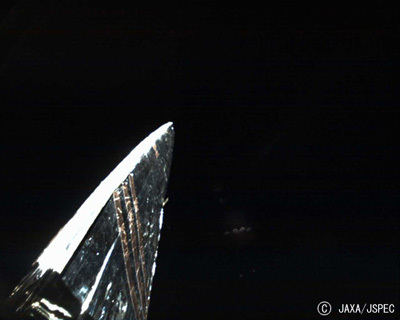
Update: IKAROS first stage deployment is now halfway complete...
Credit: JAXA / JSPEC
IKAROS first stage deployment halfway complete - A view from one of the four sail monitoring cameras on IKAROS on June 9, 2010 shows the folded sail being pulled outward from the spacecraft as it should be... (via the Planetary Society).

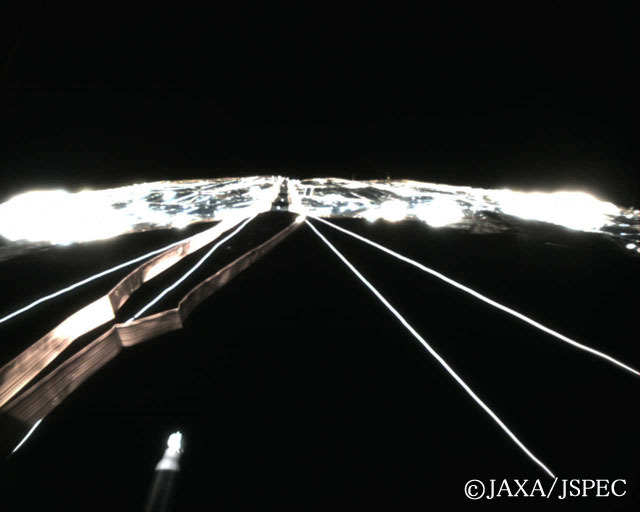
Update: JAXA are now reporting a successful full deployment of the sail, and that the sail's thin-film solar cells are now generating power. It looks like the curse is finally broken.
Credit: JAXA / JSPEC
Successful sail deployment for IKAROS (via the Planetary Society).

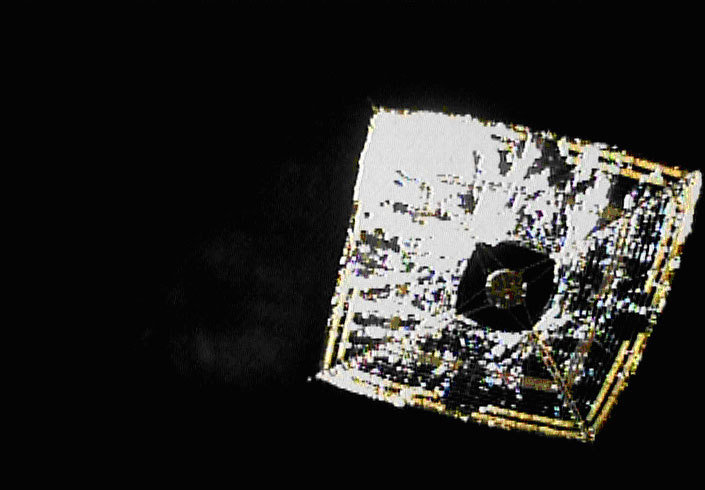
Update: IKAROS has two deployable mini-cameras, these are the first views of the fully deployed sail. Looks good...
Credit: JAXA / JSPEC
IKAROS sail from DCAM2 - One of the deployable cameras on IKAROS shows the IKAROS solar sail fully deployed. (via the Planetary Society).

Thursday, September 27, 2007

A new DAWN

After many delays, including at one stage actually being cancelled, the DAWN mission is sitting on the launch pad at the Cape. The mobile service tower has been rolled away from the Delta II, and launch is scheduled for 07:20 EDT (12:20 BST). It's actually looking like the mission is going to go this time, and you can follow the launch live on NASA TV.


Update: The launch is on hold, as the range is reported not to be clear. The Coast Guard is attempting to contact a ship which has strayed into the harzard zone, the region where the solid rocket boosters may fall back into the ocean.


Update: The ship has cleared the hazard zone, and the launch will come out of hold at 07:30 EDT, for a scheduled launch at 07:34 EDT.

Update: Lift-off...


Update: At T + 1 minute 23 seconds we have the initial solid rocket booster separation of the first six boosters, and ignition of remain three boosters.


Update: At T + 11 minutes the spacecraft has successfully achieved its planned parking orbit with an apogee of 100.6 miles, perigee of 99.99 miles and inclination of 28.6 degrees.

Update: At T + 12 minutes the spacecraft has gone out of range of the Antigua tracking station. The next communications will come when it approaches the west coast of Australia.


Update: At T + 61 minutes 58 seconds the DAWN spacecraft has successfully separated from the Delta 2 third stage.

Monday, August 13, 2007

Apples and Oranges?

More rumours that Orange might have already signed a deal with Apple to carry the iPhone in the UK and perhaps Europe.

I must admit I've been waiting for this, Orange is the only operator to have an EDGE network here in the UK. If Apple weren't going to release the iPhone with Orange, then who were they going to use? Unless as other rumours suggest the European iPhone ends up being 3G after all...

Update: More from Ars Technica...

Update: France Telecom (aka Orange) have responded to the rumours, and the associated 1.5 percent rise in their share price, with a simple "No comment", which is pretty much what O2 said...

Update: We can "neither confirm nor deny" the rumours...

Update: Orange says "Nope, not us"...

Monday, July 02, 2007

Just another Manic Monday...

It was an iPhone weekend after all, and this is very much the day after the weekend before. Just about every blog I read today had at least one iPhone post, and shockingly it's looking like it could live up to the hype and that it might actually even kick some ass. Who'd have thought?

Of course I'm sulking, and you only have to compare the U.S. and U.K. Apple Stores to figure out why. I can't buy one yet. So far we have only rumours which suggest that it'll be October before any of us here in the U.K. gets a chance at an iPhone, and we still don't know which network we'll have lock ourselves into to get one.

However as I'm off to OSCON later in the month I guess I'm going to have to stop by the Portland Apple Store and see what the fuss is all about. After all, it's the only decent thing to do...

Update: I've been seeing more and more rumours that its going to be Vodafone. Realistically I still think that has to mean a 3G iPhone because Orange have pretty much the only functional EDGE network in Europe.

Of course what I don't understand is people are taking about a U.K. and a European release in one breath. The mainland European and the U.K. markets are very different beasts and I'd be surprised if Apple tries to handle them with the same operator. Maybe it all looks the same from over on the other side of the pond, but from over here the difference between how the French or the Germans use their phones, and how the Brits do, is quite marked.

Thursday, January 04, 2007

First launch for Blue Origin

You have to give it to Jeff Bezos, he's managed a top flight skunk works project and kept it out of the media to an astonishing degree. Despite the relative secrecy surrounding places like Scaled Composites and Virgin Galactic, or for different reasons Bigelow Aerospace, I've got an educated outsiders idea of what's probably happening on the inside. Of course places like Armadillo Aerosapce are running with a fairly open business model to begin with, but not Bezos' Blue Origin.

CREDIT: Blue Origin
Blue Origin's Goddard vehicle, the first sub-scale development vehicle in the New Shepard programme, coming out of the "barn" before its launch from Van Horn, west Texas, early in the morning of November 13, 2006.

On the 7th of November last year the FAA issued a NOTAM for a series of test flights by Blue Origin between 10th to the 13th of November. While the first test was reported to have taken place on the 13th, at 6:30 am local time (12:30 UTC), very little was actually known as to what happened other than the test flight was judged successful, and the vehicle had reached an altitude of 285 ft.

So the story on BBC news today which gave the first details I've seen of the test flight of Blue Origin's New Shepard, a vertical take-off, vertical-landing vehicle, came as a surprise.


Video of the initial test flight

They're a lot further on than I, or I guess a lot of other people, thought they were. They seem to have replicated a good deal of the work done by McDonnell Douglas on the DC-X programme and might even have push beyond that, perhaps we should have expected this as the rumour is that several of the engineers who worked on the DC-X have since been hired by Blue Origin.

It really looks like Blue Origin is pushing the boundaries, and this certainly re-enforces the idea that all the interesting work on reusable spacecraft is happening in the private sector these days. My only regret is that both on the skills they need, and my obvious problems with ITAR since I'm not a U.S. citizen or resident alien, they wouldn't be interested in yet another software person. Even one with a somewhat exotic skill set...

Update: There is a good article over at MSNBC covering the flight, and they've come pretty much to the same conclusion I did. That Bezos' has only released this footage so that he can recruit some new people with heavy lifter experience. He's looking for people with experience with Delta IV or Atlas V, and those aren't small vehicles. Blue Origin isn't in the sub-orbital business like Scaled Composites and Branson, no matter what Bezos is saying right now they're playing a longer game and working towards an full blown single stage to orbit lifter.

Update: I'm in good company, as it looks like John Carmack thinks that this might be a sub-scale prototype of a SSTO vehicle as well,
When we saw the weight listed in the papers filed with the FAA, I thought that the only reason to build a suborbital vehicle that large would be if you intended to also boost upper stages for orbital work, but it doesn't look like the shown design would be appropriate for that. Maybe it is a subscale version of an SSTO, or a nearly-SSTO upper stage intended to be boosted by an even larger straight-up-straight-down VTVL. - John Carmack, Armadillo Aerosapce
Update: John Carmack's comments on the Blue Origin test have got me thinking. Unlike Blue Origin's Goddard, Armadillo's Pixel and Texel don't have an aeroshell. I'm wondering why that is? We know that Blue Origin's FAA permit allows them to go higher than Armadillo, but how high? I guess I need to dig out the permits and compare them, but I'm thinking the aeroshell is significant. Perhaps not technically, but it shows that the two companies are taking very different approaches to the business, if that wasn't immediately obvious from the way they approach publicity. It'd be hard to find a more open approach to prototyping than John's in-depth discussion of the design work going on at Armadillo after all. But ignoring that you can tell a lot about Pixel's design by looking at pictures, but there is very little you can get out of the pictures of Blue Origin's Goddard. So my bet is that Blue Origin will retreat back into their "cone of silence", as Carmack puts it, after they manage to recruit the people they need and it'll be a while before we hear from them again...

Update: I just dug up the environmental impact statement (19.5MB, PDF) from the FAA's web site. I'm not going to trawl through the 200+ pages in too much detail, but it does confirms its use of a high-test peroxide mono-propellant which is something I was wondering about as the burn looked way too clean to be a bi-propellant.

Sunday, December 10, 2006

Spectacular launch

In the first night launch since the Columbia disaster in 2003 the Space Shuttle Discovery sucessfully took off from Cape Canaveral in the early hours of this morning.

CREDIT: Nigel Cook/AP/New York Times (via Digg)
A shot of the launch from Daytona Beach, Florida