Tuesday, March 10, 2009

ETech: Tuesday morning keynotes

I'm back in the main room for the Tuesday morning keynotes. We've got Alex Steffen talking about Sustaining the American Family, Sameer Padania talking about WITENESS: Capturing Crisis and Mary Lou Jepsen talking about Low-cost, Low-power Computing.


...and here's Brady Forrest and a $20 computer

Brady kicks us off , and this morning we're going to be talking about sustainability. Right now we're moving away from a period of abundance into a period of constrains...


Alex Steffen talking about sustainability

First up is Alex Steffen talking about the developing world and the potential to see peak population in our lifetime, along with our historic carbon. He's arguing our current lifestyle is a massive inter-generational ponzi scheme.

The poor's job is to get rich. Our job is to reinvent what rich means...

If poor people follow our, the western world's, route to wealth we will ruin the world.

We're the brittle rich...

We're utterly depending on the rest of the world doing the right thing for us to continue to enjoy any sort of lifestyle. We need for them to agree to make changes, and for that to happen they have to see us make changes. We're going to have change an awful lot of things...


Energy meters reduce energy usage

That's an interesting statistic, apparently studies have shown that bringing an energy meter into the house reduced energy usage by between 10 and 15%, without doing anything else, just by showing people the energy they are using...

He's arguing that one day you won't be able to throw things away, because there won't be anywhere to throw it. We're moving towards closed loops are reuse. The more you take the long view, the more it's obvious we're all in this together. If we're only concerned about our own prosperity, we're going to loose that prosperity.


Sameer Padania talking about capturing crisis

Next up is Sameer Padania from WITNESS, a human rights organization, who is talking about one of their projects called The Hub a social media project, and the affect of technology on how complicated it is to get footage and reports of human rights violations out of crisis zones and out to the world.

However although activists are using these new technology to capture abuses, the perpetrators are starting to use the same technologies to distribute videos and pictures of abuses to intimidate the local communities.

People are risking their lives to film the content, but with the growing amount of content, how do we aggregate and analysis the content so that important information isn't lost and it's the material is properly put into context in real time?


Mary Lou Jepsen talking about low-cost computing

The final talk of the keynote is by Mary Lou Jepsen who is talking about low-cost, low-power computing and giving computing to the other five billion people on the planet. Today, 97% of adolescents alive today live in the developing world, if you want to change the world the future is there.

Mary is talking about the one laptop per child project which she co-founded, and she's pointing out that despite the controversy surround the project there is now a million kids in the developing world that have laptops that wouldn't otherwise.

But that's not the only affect, the entire small inexpensive laptop market has grown out of this project. Not just in the developing world, but also first world, where the netbook form factor has taken off. The landscape is changing in the laptop industry, last year more than double the number of netbook units shipped than was initially predicted. Next year, it'll be more again...

People are starting to innovate at the bottom of the technical pyramid, high-end, high-tech research is all about trickle down economics. Why not work at the bottom of the pyramid and people get access to the new technology now?

...and we're done.

ETech: Ignite ETech


After a quick break we're back for Ignite ETech.

If you had 5 minutes on stage what would you say? What if you only got 20 slides and they rotated automatically after 15 seconds?

Brady is back and introducing Ignite. We've got nine speakers, and at least one t-shirt that's going to be fired from a cannon. Ignite talks are 20 slides for 15 seconds a slide for a five minute.


Jan McGonigal

The first speaker is Jane McGonigal who is speaking about Free Space, a new forecasting game to be played this week at ETech.


The year is 2019. Personal satellites are cheap and accessible at $100. What would you use yours for?


Tom Gomez

Next up is Tom Gomez, deputy editor of wired, who is talking about a writing his book, the Decision Tree. Medicine as an algorithm...


Molly Steenson

Next up is Molly Steenson, who is talking about the history of pneumatic tubes for sending messages and packages in the 19th century. Interesting, Ted Stevens was right, just 100 years late.


Niall Kennedy

The next speaker Niall Kennedy is talking about measuring cloud efficiency.


Rose White

A change of pace, Rose White talking about knitting, and knitting as graffiti...

It's not your grandmother's knitting!

Knitting was once proprietary, reserved for the nobility, and was reverse engineered and made available to everyone.


Tom Igoe

An Arduino interlude by Tom Igoe and what's going on with the Arduino today. Most of what has been going on has been incremental improvements. There are not enough pins, memory, or serial ports.


The new Arduino MEGA

He's announcing the release of the Arduino MEGA, with a lot more capability. It should be available sometime next week.


Tariq Korula

Our next speaker is Tariq Korula, talking about the Ybike - the solar powered, Flickr uploading, geo-tagging photo bike. That's 20 bikes, 11 cites, 5 continents, 63,718+ photos. Search for the ybike tag on Flickr. Ghosts in the machine, or a million monkeys?


Brad Templeton

Our penultimate speaker is Brad Templeton from the EFF, talking on evil. We started with time sharing, moved to personal computers, and now we're back to time sharing. Your data is our of your hands, again. Ease of use can be a bug, if you make it easy to do, people will do it more.


Bill Gurstelle

Our final speaker of the evening was Bill Gurstelle who talked about the art of living dangerously. It's not a good thing to blow up things, but you should live dangerously...


Bill Gurstelle and his t-shirt cannon

...and we're done!

ETech: Monday evening keynote

After a very quick dinner I'm sitting in the Monday evening keynote waiting for Tim O'Reilly's to give his annual O'Reilly Radar...


Brady Forrest introducing Tim O'Reilly

Brady Forrest opened the show and introduced Tim, who is here to talk about the pilosophy that drives O'Reilly and stuff that matters...


Tim O'Reilly and stuff that matters...

These are pretty tough times... some things are being preserved, while some things are falling into ruin...

But what are our best and brightest doing? Throwing sheep on Facebook. Last year at the Web 2.0 conference Tim told people to work on stuff that matters,

Alot of people thought I was saying to work on non-profits, or maybe social ventures... I'm actually sauing that the world's great challenges is also the world's greatest opportunities.

But he's pointing to Better Place who are attempting the pioneer an new business model for electric cars,

Some of the things we think are so important today, are actually getting in our way...

He's talking about other power and energy companies like his son-in-law's company that's just come out of stealth, Makani Power working on high-altitude wind power systems. We have to get rid of about 8 terrawatts of fossil fuel energy and replace with renewables. Just because it's worthwhile, doesn't mean it isn't going to make money.

This attitude has started to bubble up form small companies to larger companies and agencies, like Google, and the NASA-Cisco climate project to flash the "planetary skin'. IBM has made it a center point of their new advertising campaign, a smarter planet, and instrumented, interconnected planet.

The idea of tackling big challenges, and bringing people along with us is what we have to do...

Talking about "big hairy audacious goals" Tim is now talking about public access to government data and has announced a new conference called the gov2.0 Summit which will be in Washington DC in September.

If you're not paying attention to what's happening to open government data, we have an opportunity that is unprecedented. We have a great challenge, but also a great opportunity. We have about 2 years to make a difference in the current administration...

He's talking about long term goals and the Long Now Foundation and scenarios for future planning, and the idea that there can be discontinuities, and we're in the middle of one just now. Both a financial one, and an environmental one.

The core of scenario planning is to develop a strategy that will be robust against any of the extreme strategy. Tim is urging us to think that way, think about what are the extremes in our lives, our business and figure out what are things that will be worth doing in the face of any of those extremes.

We're entering an era of choose your own adventure...

We're being told to find a place where you can make a difference, but make it count, like the $100 house...

Work on something that matters to you more than money. That's in the realm of things that matter.

Like deliberately unsustainable business models. If you're thinking about startups, stop thinking about whether it's going to succeed or not, and start thinking about what you're going to do instead. You need to create more value than you capture.

You guys are inventing the future, and what we want to do is help you spread the world, take on those giant challenges and eventually change the world.

Be minimal, leave places for other people to do things, and be friendly to people that extend you.

Update: Slides from Tim's keynote talk are now up on slideshare.net.

Monday, March 09, 2009

ETech: Hands-on RFID for Makers

My afternoon tutorial is Hands-on RFID for Makers given by Tom Igoe and Brian Jepson. We've been given, well purchased, but you know what I mean, an Arduino mini pro, a bread board and a SonMicro SM-130 module to allow us to read and write to the Mifare RFID tags that O'Reilly are using here at ETech.


The finished tag readers

We kicked off by accessing the card reader directly from our laptops using Processing and Tom's SonMicro library, first to just read from the card and then to write to it...

Once we got that working we moved to an Arduino-based reader that reads Mifare tags and stores them. From there we moved on to the hooking our RFID readers up to the to web and the O'Reilly conference database, with Processing providing a GUI interface to the Arduino code.


Long time readers of this blog will know that I have some, lets call it philosophical problems, with some of the proposed uses of RFID technology. But that said, there are some really interesting things you can do with tags, and while I approached this tutorial in a "know your enemy" frame of mind it was really fun, and I'm probably going to try and play with tags some more when I get back home. For instance, I can see some uses for the technology in the distributed sensors stuff I'm working on these days...

...of course that was all probably helped by the fact that Tom ran one of the clearest, well documented, hands-on tutorials I've seen. If you've got the opportunity to take a course with him, do it, you'll enjoy yourself.

Update: Pat was also blogging this one...

ETech: The LilyPad Sweatshop

I'm sitting in Leah Buechley's Lilypad Electronic Fashion tutorial. Where we'll be playing with Lilypad Arduino kits, a collection of sewable electronic pieces that lets you build soft electronic devices. Essentially it's a specially packaged Arduino, a sewable computer.

The materials are strange and hard to work with... - Leah Buechley


Hacking (and sewing) electronics


The aim for the workshop was to produce a "soundie", a garment which produes a sound when touched in a certain place, or different sounds when touched in different ways. Issued with a SparkFun LilyPad Pro Kit, some conductive thread, conductive material for the touch sensors, and of course a needle, we set to work. Well after the obligatory jokes about how this was going to look on our expense reports obviously...


The LilyPad t-shirt

Despite my awful stitching I actually managed to get my garment working, and if you see me around ETech wearing my conference t-shirt, slap me on the shoulder. The t-shirt will scream for me, so I don't have to...

ETech: Unevenly distributing the future again

I'm currently in San Jose for the 2009 O'Reilly Emerging Technology Conference, and much like last year we're unevenly distributing the future yet again. We'll be talking about synthetic biology, sensors and smart content, urban homesteading, making art with lasers and high tech chocolate.

...there are somewhere between six and ten billion people. At any given time, most of them are making mud bricks or field-stripping their AK-47s. - Neal Stephenson, Snow Crash p.26

Suffice to say that we're not going to be in the majority, unless things go very wrong there won't be a mud brick or an AK-47 to be seen all week.

ETech is one of those rare conferences where you get to hole up in a nice hotel and sit down and think about things for a week. Day-to-day you very rarely get time to do that, I'm going to try and not waste the opportunity...

Tuesday, February 24, 2009

The perils of provider lock-in

I run a consulting and contracting company. I do some Perl, Objective-C, the odd bit of hardware, and write apps for the iPhone. My business cards all have the same phone number on them, which is a dial-in number attached to a VoIP account with the Gizmo Project.

Up until a week ago this worked fairly well. When I was on the move I either picked up calls from my laptop, or if I missed them, voice mail got forwarded to me via email. When I was at home I used a hardware SIP phone on my desktop, and voicemail still got emailed to me if I missed a call.

What's gone wrong? Well the number doesn't work anymore and, at least according to customer support, Gizmo doesn't have a clue as to when it might start working;

Our provider for your number in the United Kingdom is experiencing technical problems with their numbers. They are working on this issue but have been unable to provide us with a time frame for when these numbers will be functional.

To remedy this situation we have 2 options for our customers:
  1. Offer you a replacement number
  2. If you would like to keep your number, we will extend your expiration date to cover the time it was down once the numbers are restored and functioning normally.

Please respond to this email to let us know of your decision. We are sorry for the inconvenience this may have caused and look forward to getting this resolved quickly.

This is not the best customer service I've ever experienced. It wouldn't be quite so bad if the number just dropped straight to answer phone, but it doesn't even do that. Effectively, if you want to reach me by phone about my business, you have to already be doing business with me and have my mobile number. This isn't great, it's all about first impression after all.

After talking with a friend who does this sort of stuff for a living it looks like I'm pretty much stuck at this point, number portability for landlines is in its infancy in the UK. My guess? The provider has gone bust in the current recession and I'm not getting my number back.

Lesson learned. For something as important as a phone number, provider lock-in is a real problem.

Tuesday, February 17, 2009

New for the iPhone, AWS Calculate

Following on from my previous iPhone application which allows you to monitor the status of various cloud computing backend services, and continuing with the Cloud Computing themed applications. I'd like to announce the release of my next iPhone application onto the App Store...


AWS Calc for the iPhone 3G and iPod touch.

Cloud Computing makes it easy to build applications that run reliably, even under heavy loads. But the larger the load, the higher your cost.

The AWS Calc application allows you to estimate your monthly costs based on your current Amazon Web Services (AWS) usage levels, and then lets you estimate how much a sudden usage spike could cost.

Saturday, January 24, 2009

Tinker.it Toy Hacking Workshop

I'm in the depths of central London for this years Tinker.it Toy Hacking Workshop.


Toy Hacking Lab from Matt Biddulph.

The pictures from last years workshop make this look like a fun event, and I'm looking forward to getting my soldering iron out and playing with toys. Both the grown-up and not-so-grown-up kinds.

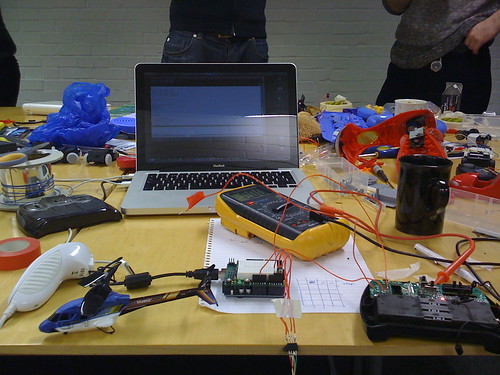
Judiciously plundering my pile of junk at home I came up with a RC controlled micro-helicopter, an old Nokia 6100, a rather ancient USB web camera, a Bluetooth GPS module and an LED torch. Adding a couple of Arduinos, a LV-MaxSonar-EZ1 range finder and a 16×2 serial LCD panel to the pile I threw everything into a box, hoping they might come in useful. But no, I have no idea what I want to build. Hopefully I'll come up with something during the course of the weekend...

Update (24/Jan): We spent the the first day of the workshop playing around with radio controllers and some simple toys, and formulating our nefarious plans for world domination...

Posted on Flickr by aallan.
Hacking radio-controlled bumper cars...

...and you only had to look at evil Harmony Bear and Bubbles the Dog to know that our twisted minds were working at a feverish pace.

Update (25/Jan): Sunday was project day and I'd already decided I wanted to hack the radio-controlled micro-helicopter I'd brought with me...

My original plan was to hook the controller unit into an Arduino and try and control the copter from the command line. But Chris Loxton, the man behind evil Harmony Bear, had brought a Wii Nunchuk controller with him, so in the end I had a better plan. I hooked the Nunchuk up to the Arduino, making use of Tod Kurt's nunchuck_funcs.h library code, and then the Arduino in turn to the helicopters controller unit.

Posted on Flickr by aallan.
The hacked helicopter and Wii nunchuck controller

After hacking some code out the helicopter was, at least in theory, going to be controllable using the Nunchuk's 3-axis accelerometer.

The controller for the helicopter was fairly interesting, with the power and direction controls turning out to be digital rather than analog. Presumably to save money the rotor power control was digitally encoded into four bits using multiple contacts on the control lever, removing the need to provide any analog-to-digital circuitry, and as it happens simplifying the hack enormously.

By the end of the day, sure enough, I had actually successfully managed to get fairly rough control over the helicopter and I was pretty pleased with myself...

If I get another free weekend, I think I can move this hack forward quite a long way. Removing the excess foam from the helicopter itself will probably save enough weight to allow me to attach an accelerometer and an XBee module directly onto the helicopter. The data from the accelerometer can then be transmitted via the XBee to an XBee enabled Arduino which is also hooked to the hacked radio controller so that it can send commands back to the micro-helicopter, closing the control loop. Effectively I should be able to build a self-stabilising helicopter. Unless I'm explicitly sending a command to move the micro-copter, it should just hove in place, correcting any random movements cause by trim or other nagging problems like drafts and air-conditioning.

Monday, January 19, 2009

New for the iPhone, Cloud Status

Paul Graham, one of my favourite dispensers of wisdom, argues that the arrival of web based software has changed not just the user experience, but the developer experience as well.
One of the most important changes in this new world is the way you do releases. In the desktop software business, doing a release is a huge trauma, in which the whole company sweats and strains to push out a single, giant piece of code. Obvious comparisons suggest themselves, both to the process and the resulting product. - "The Other Road Ahead", Paul Graham

Which is exactly right. Working in the cloud you rarely make a software release in the old sense of the word. Despite the benefits I must admit I actually somewhat miss the "big push" where, usually with a great deal of trepidation, you roll out a new improved version of a piece of software.

So it's with a certain sense of nostalgia, about the days before web applications started killing off the desktop, that I'd like to announce the release of my first iPhone application onto the App Store...


Cloud Status for the iPhone 3G and iPod touch.

Cloud computing makes it easy to build applications that run reliably, even under heavy loads. However as a developer you need to know if and when the cloud, and hence your application, is having problems.

Cloud Status allows you to monitor the status of Google App Engine, Amazon Web Services and Twitter in real time. When they know they have problems, you are the next to know.