The often deranged postings of yet another hacker, pretending to be an Astronomer, pretending to be a hacker who has written a book or two for O'Reilly Media.
I spent last week at the O'Reilly Media OSCON conference where I was talking about using the OpenCV library to do face detection on the iPhone using Haar classifiers.
The talk walked you through the cross-compiling and building a static distribution of the library that you can link to your application and make use of from both the simulator and the iPhone hardware itself, and how to build a simple application to perform face recognition on images taken directly using the device's camera.
Download the talk as a PDF (4.4MB), or view it on iWork.com. The associated visualization by Adam Harvey and sample code (20.8MB) built during the talk are also available.
Yesterday the Japanese successfully launched three Venus-bound spacecraft: the Akatsuki Venus orbiter, the IKAROS solar sail, and a University-built UNITEC-1 mini-satellite.
In doing so it broke one of the longest running jinxes in spaceflight, it managed to sucessfully put a solar sail spacecraft in orbit. The last time this happened was in 1993 when the Russian Znamya-2 experiment, a spinning sail 60ft in diameter which was sucessfully deployed from a Progress vehicle after undocking from MIR.
The followup experiment in 1999, Znamya-2.5, was a failure after the sail became entangled in a antenna during deployment. The funding crunch that then faced the Russian space programme meant that the ambitious Znamya-3 followup mission, consisting of a 200ft diameter sail deployed from another Progress craft, which was to fly in 2000 or 2001, was unfortunately cancelled.
Around that time the Planetary Society attempted a sub-orbital launch of a prototype solar sail, a flight designed to test a new technology for unfurling solar sail blades, which failed due to a problem with the launch vehicle. The subsequent launch their Cosmos-1 solar sail vehicle in 2005, from a Russian nuclear submarine in the Barents Sea using the same Volna launch vehicle, also failed. Despite their initial optimism, their Cosmos-1 spacecraft did not achieve orbit. Despite this set back, the Planetary Society are still persevering with plans for a fresh mission called Lightsail-1 with a planned launch date around the end of the year.
CREDIT: NASA
NASA's Nanosail-D satellite during deployment testing
A similar fate to the Planetary Society's Cosmos-1 mission befell NASA's NanoSail-D mission which was lost in a launch failure during the third flight of SpaceX's Falcon 1 rocket in 2008. Despite the sub-orbital tests flown by the Japanese back in 2004, presumably as a pre-cusor to yesterday's IKAROS launch, it seemed that solar-sail mission just couldn't get off the ground.
However, despite the apparent break in the curse associated solar sail missions, the Japanese have yet managed to deploy the sail. The IKAROS spacecraft is currently undergoing in-flight checkout before a scheduled deployment of the sail in a few weeks... fingers crossed.
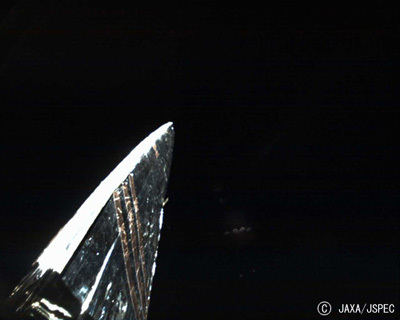
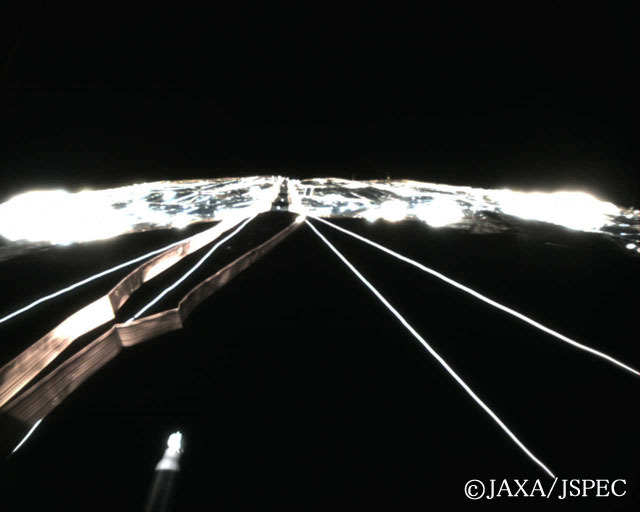
Update: IKAROS first stage deployment is now halfway complete...
Credit: JAXA / JSPEC
IKAROS first stage deployment halfway complete - A view from one of the four sail monitoring cameras on IKAROS on June 9, 2010 shows the folded sail being pulled outward from the spacecraft as it should be... (via the Planetary Society).
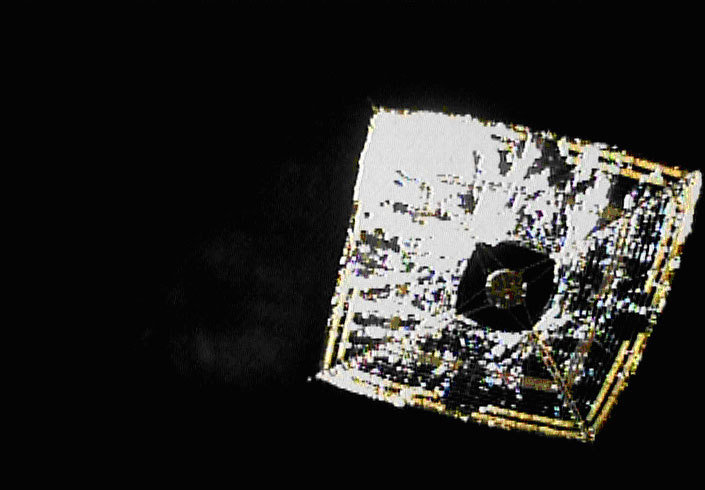
Update: JAXA are now reporting a successful full deployment of the sail, and that the sail's thin-film solar cells are now generating power. It looks like the curse is finally broken.
Jonathan argued that today's technological market is dominated by two contrasting business models: the generative and the non-generative. The first model, general purpose computers, allow third parties to build upon and share through them. The second, non-generative model, is more restricted, with appliances that can only be modified by the vendor. He is very much afraid that the second model, where we are locked in by vendors is coming to predominate.
I don't think my opinions on this have changed much in the last two years. The iPhone, and now the iPad, are held up as being evil for being closed platforms. I don't think that's a problem. There is plenty of room for closed platforms.
Cory Doctorow argues that the next generation of kids won't be able to grow up and become programmers. That buying an iPad sends the wrong message to your kid, that the world isn't yours, it's something you have to leave to professionals.
Buying an iPad for your kids isn't a means of jump-starting the realization that the world is yours to take apart and reassemble; it's a way of telling your offspring that even changing the batteries is something you have to leave to the professionals. - Cory Doctorow
I think he's dead wrong. Technology has moved on, and the world is changing. What is changing is that we’re in the transition phase away from one model of computing and towards another. I’d argue that the underlying trend is towards more openness, not less. It's just the things that are open and the things that are closed are changing, and with that the skills you need to work with the technology.
We're moving away from general purpose computers towards more purpose specific devices. Amoung these are the iPhone and the iPad. However the passing of the desktop computer, and the Web, is not the problem people should be worrying about. The important thing for people to hang onto is the infrastructure, the pipes themselves. The Web isn't the Internet, the Internet existed before the Web and it'll be around a long time afterwards. So long as we have the pipes the content flowing across them is really rather irrelevant. I'm far more worried by threats to network neutrality than I am by the death of the general purpose computer.
The only thing that's changing here is that the tools and skills you need to play with the next generation of technology; ubiquitous computing, embedded devices, mobile devices. So you'll need different skills than you might have used to play with the last generation of technology? The fact that you have to go out and learn some electronics to take part in the next big thing isn't such a big deal. You're supposed to like learning new things. Go buy a soldering iron and stop worrying about vendor lock-in so much...
I'm at the LikeMinds conference here in Exeter today talking about social media. I'm not amoung my people, the room is mostly filled with marketing and public relations types. While I'm sure I'm not the only techie here, I may be the only professional scientist...
But what I didn't expect to here this morning was a question from the audience during the social strategies panel with John Bell, Maz Nadjm, Charlie Osmond and Gemma Went, "...how can I stop my scientists talking online?"
@aallan "...stop scientists talking"?! Why do they want to do that? Do they worry the Internet might be full?
The issue seems to be that those naughty scientists are talking about restricted intellectual property between themselves without proper oversight from management types. Oh dear, we might come up with ideas and solve problems without the right paperwork getting done..?
Have they heard of the printing press, and peer-reviewed journals? Science, rather than the scientists themselves, have a problem with restricting communication. Science can't happen without communication. You only have to look at the how science was done before peer-review journals became prevalent, when theories were published first as anagrams, to realise how the velocity-of-change of technological and scientific progress depends crucially on open communications.
We talked about this at the .Astronomy meeting in Leiden at the tail end of last year, but crucially we weren't talking about stopping scientists talking. We were talking about how to make it easier, to make it open...
Michael Nielsen - Reinventing Discovery
...Michael Neilson's talk was about the future of science and how to build a collective future for all of us, and combat the silo mentality that this question of how to "...stop scientists talking" exemplifies.
You have to wonder if this person was worried about today's social media, what she'll think of open science, open data access, and .Astronomy's project #zombie...
I'm in Leiden this week at the Lorentz Centre for the .Astronomy Meeting. If you're not lucky enough to be here, we're streaming the mornings live so you can sit in on the talks...
The term digital nomad is starting to break into the mainstream. To some it's all about work from anywhere; your local library or coffee shop, the hotel pool, a co-working space. But lately it seems that anywhere has become a much broader term. Sell your house, your car, your furniture, pack your bags and buy a ticket to somewhere, anywhere, that isn't here. The plan is to earn a first world salary by telecommuting, but pay third world prices for food and shelter.
The nomand's lifestyle is defined not by how many hours a day they're online, but by when they're not. Emily Davidow has it right,
Last weekend, an uncle asked me “How many hours a day do you go online?” I looked up from my iPhone and repeated the question out loud several times... “All of them,” my wise brother answered. “She doesn’t go online, she just is.” Uncle seemed confused and more than a little worried. - Emily Davidow
I've been a semi-nomad for the last decade, I didn't sell my house or my car and just go. I've always had somewhere to come back to, but I've travelled a lot. At the peak, a few years back now, I was spending six to nine months of the year out of the country. Although over the last year or so, for obvious reasons, I've scaled back the amount of travel I'm doing, I must admit I sometimes have a wistful thought or two. Looking out a hotel window on a new view, or sitting watch the world go by, or even a quick dose of culture shock is a different life than dragging myself into the office every morning. No matter how much I enjoy what I do for a living...
However this weekend I sat on my couch at home in-front of a roaring fire as the severe weather raged outside. Surrounded by three laptops, my iPhone and an iPod touch, I was working on the second draft of my upcomimg book. I could have been anywhere in the world, but I was at home. Why? Because while I could have been anywhere in the world, I chose to be at home. After a decade of semi-nomadic existence, where else is really as comfortable?
At the start of December I'll be kicking off the Where 2.0 Online Conference talking about iPhone sensors. My introductory session is intended to be the foundation for the rest of the event and is based on the sensors chapter of my upcoming O'Reilly book Learning iPhone Programming. I'll be going over the sensors available and talking about how to access them, then I'll deep dive into the accelerometer and attempt to build an accelerometer based application, live on camera. I'm not sure how they talked me into that...
I'll be followed by four app developers who will each focus on the sensors they used in their respective apps. They will cover their tools, their process and their mistakes. Andreas Alfare will be talking about augmented reality, Ian Peters-Campbell will be talking about location sensors, Martin Roth about working with audio and Jeffrey Powers about computer vision.
Admittance is US$149, and participants will receive an advance copy of Chapter 10 of my book, the chapter talking about sensors, as a part of the conference fee. If you'd like to register, but you're thinking that's a bit steep, I can offer you 25% off as a "friend of the speaker", use the discount code whrfall09fsp when you register. It's should be a lot of fun, if you only to see me attempting to code on camera...