Thursday, February 03, 2011
Interview on Machine Learning
This week I've bee out at Strata, and earlier today I was interviewed by interviewed by Mac Slocum for the O'Reilly Media YouTube channel about my talk on Machine Learning in the Real World and other related topics.


Machine Learning in the Real World
Today I gave a talk on machine learning in the real world at O'Reilly's Strata Conference. Can machines help us make better decisions? During the panel we looked at how machine learning is applied in industry and academia to optimise the use of resources and help with decision support.
|
Alasdair Allan talking about "Machine Learning in the Real World" at O'Reilly Media's Strata Conference in 2011. |
Thursday, November 04, 2010
Cloud Status v4, for the iPhone
It has been a while since the last release of Cloud Status, my Cloud Computing monitoring application for the iPhone and iPod touch. So I'm really happy to announce a new release, version 4.
Predictably with such a long time between updates there have been major changes. Along with a number of minor bug fixes, and an updated UI, the application has been fully updated to support iOS4 and the iPhone 4's retina display.

Reporting for MS Azure and the Rackspace Cloud has been added in addition to the existing status reporting for Google App Engine, Google Apps and Amazon Web Services.
The best part? This new release of Cloud Status is now available for free thanks to the generous support of WatchMouse, the application and website monitoring people.

Predictably with such a long time between updates there have been major changes. Along with a number of minor bug fixes, and an updated UI, the application has been fully updated to support iOS4 and the iPhone 4's retina display.
Reporting for MS Azure and the Rackspace Cloud has been added in addition to the existing status reporting for Google App Engine, Google Apps and Amazon Web Services.
The best part? This new release of Cloud Status is now available for free thanks to the generous support of WatchMouse, the application and website monitoring people.
Thursday, September 02, 2010
Science Online London 2010
So this weekend I'm attending Science Online London at the British Library. A two day conference aimed at exploring how the web is changing the way we conduct, communicate, share, and evaluate research.
Tonight I managed to just miss out on the pre-conference pub crawl. My train pulled into London about the same time as the crawl was scheduled to roll out of the Cittie of York and onto the Ye Olde Mitre. Since the Mitre is notorious as being "London's most hidden pub" I decided that I'd probably shouldn't try and find even a relatively large crowd of drunk(en) science bloggers under my own steam at that point...
However as well as the first day of the conference proper, tomorrow night is the Frivolous Rooftop Debate hosted by Mendeley at their office in Clerkenwell. From the accounts of last year's event I'm really looking forward to it, and I'm hoping for a vaguely Foo-like experience from the un-conference programme...
...if you can't be there Science 3.0 is live-casting the event and of course you can follow along on Twitter, the hashtag for the event is
Tonight I managed to just miss out on the pre-conference pub crawl. My train pulled into London about the same time as the crawl was scheduled to roll out of the Cittie of York and onto the Ye Olde Mitre. Since the Mitre is notorious as being "London's most hidden pub" I decided that I'd probably shouldn't try and find even a relatively large crowd of drunk(en) science bloggers under my own steam at that point...
However as well as the first day of the conference proper, tomorrow night is the Frivolous Rooftop Debate hosted by Mendeley at their office in Clerkenwell. From the accounts of last year's event I'm really looking forward to it, and I'm hoping for a vaguely Foo-like experience from the un-conference programme...
...if you can't be there Science 3.0 is live-casting the event and of course you can follow along on Twitter, the hashtag for the event is
#solo10.
Tuesday, August 31, 2010
O'Reilly iPhone Sensors Masterclass
While I was in the States last month, in-between attending OSCON in Portland, SciFoo in Mountain View and my flying visit to New York, I headed up to Spreckles Theatre in Rohnert Park, CA, to film an O'Reilly Masterclass in "Making use of iPhone and iPad Location Sensors."
The class guides you through developing applications for the iPhone and iPad platforms that make use of the onboard sensors: the three-axis accelerometer, the magnetometer (digital compass), the gyroscope, the camera and the global positioning system. During the four and a half hour class, amongst various other topics, I talked about face detection on the iPhone and walked through building an Augmented Reality toolkit.
The class is now available for US$99.99 from the O'Reilly Media website.
Included in the price is the full four and half hours of video, a copy of the slides I used on the day with added commentary, fully working Xcode projects allowing you to build and follow along with all the code we built during the class, and two preview chapters from my upcoming book "Programming iPhone Sensors" covering some of the material I talked about during the class.
If you want to see the sort of content you'll get you can view a free preview of the section of the course where I introduce the iPhone accelerometer, and if you're still wavering O'Reilly is running a "Buy 1 video, get 1 free. Buy 2 videos, get 2 free..." promotion all through September. Just enter code "BVGVF" in the O'Reilly shopping cart.
 |
 |
| Demo'ing the AR toolkit we built during my O'Reilly Masterclass |
The class guides you through developing applications for the iPhone and iPad platforms that make use of the onboard sensors: the three-axis accelerometer, the magnetometer (digital compass), the gyroscope, the camera and the global positioning system. During the four and a half hour class, amongst various other topics, I talked about face detection on the iPhone and walked through building an Augmented Reality toolkit.
The class is now available for US$99.99 from the O'Reilly Media website.
Included in the price is the full four and half hours of video, a copy of the slides I used on the day with added commentary, fully working Xcode projects allowing you to build and follow along with all the code we built during the class, and two preview chapters from my upcoming book "Programming iPhone Sensors" covering some of the material I talked about during the class.
If you want to see the sort of content you'll get you can view a free preview of the section of the course where I introduce the iPhone accelerometer, and if you're still wavering O'Reilly is running a "Buy 1 video, get 1 free. Buy 2 videos, get 2 free..." promotion all through September. Just enter code "BVGVF" in the O'Reilly shopping cart.
Friday, July 30, 2010
Sci Foo 2010
I'm currently on my way to the Googleplex for this year's Science Foo Camp (SciFoo). Based on the original O'Reilly Foo Camp unconference model, there's no agenda until the first evening when the attendees collectively create one, SciFoo is a gathering of "leading scientists, technologists, writers and other thought-leaders" for a weekend of discussion, demonstration and debate.
From SciFoo 2009 - Charlotte Stoddart
I'm absolutely amazed and delighted to be here for SciFoo amougst some great people, it's going to be an amazing weekend...
From SciFoo 2009 - Charlotte Stoddart
I'm absolutely amazed and delighted to be here for SciFoo amougst some great people, it's going to be an amazing weekend...
Monday, July 26, 2010
iPad iPhone Summit
For those of you who didn't get the chance to go to O'Reilly's OSCON I'll be giving my talk on Face Detection on the iPhone again at the online iPhone iPad Summit run by Environments for Humans. It's an all-new, all-day online conference, on the 25th of August running from 9am to 5pm (CDT).
Talking will be Jesse MacFadyen on the PhoneGap project, myself on face detection on the iPhone, David Kaneda on Sencha Touch, Jonathan Stark on offline web applications using HTML 5, Simon St. Laurent on client side data storage using HTML 5, Suzanne Ginsburg on iOS and the user experience, Dan Rubin on mobile design and CSS3 and Aral Balkan on the Feathers App.
Use the discount code IPPSALLAN will get 10% off the ticket price for both individual or meeting room tickets. The ticket price includes a free iPhone ebook from O'Reilly!
Talking will be Jesse MacFadyen on the PhoneGap project, myself on face detection on the iPhone, David Kaneda on Sencha Touch, Jonathan Stark on offline web applications using HTML 5, Simon St. Laurent on client side data storage using HTML 5, Suzanne Ginsburg on iOS and the user experience, Dan Rubin on mobile design and CSS3 and Aral Balkan on the Feathers App.
Use the discount code IPPSALLAN will get 10% off the ticket price for both individual or meeting room tickets. The ticket price includes a free iPhone ebook from O'Reilly!
Sunday, July 25, 2010
Interview on iPhone Sensors
While I was at OSCON last week I was interviewed by Mac Slocum for the O'Reilly Media YouTube channel about my talk on Face Detection for the iPhone, augmented reality and mobile sensors in general.
To be honest we actually covered the best material after the camera stopped rolling, as we moved sideways onto ubiquitous computing, which is one of my most ridden and favourite hobby horses, and on using distributed data to allow us to make better real-time decisions. Maybe next time...
To be honest we actually covered the best material after the camera stopped rolling, as we moved sideways onto ubiquitous computing, which is one of my most ridden and favourite hobby horses, and on using distributed data to allow us to make better real-time decisions. Maybe next time...
Face Detection at OSCON
I spent last week at the O'Reilly Media OSCON conference where I was talking about using the OpenCV library to do face detection on the iPhone using Haar classifiers.

The talk walked you through the cross-compiling and building a static distribution of the library that you can link to your application and make use of from both the simulator and the iPhone hardware itself, and how to build a simple application to perform face recognition on images taken directly using the device's camera.
Visualising Haar Classifiers from Adam Harvey.
Download the talk as a PDF (4.4MB), or view it on iWork.com. The associated visualization by Adam Harvey and sample code (20.8MB) built during the talk are also available.
The talk walked you through the cross-compiling and building a static distribution of the library that you can link to your application and make use of from both the simulator and the iPhone hardware itself, and how to build a simple application to perform face recognition on images taken directly using the device's camera.
Visualising Haar Classifiers from Adam Harvey.
Download the talk as a PDF (4.4MB), or view it on iWork.com. The associated visualization by Adam Harvey and sample code (20.8MB) built during the talk are also available.
Friday, May 21, 2010
Jinx on Solar Sail missons finally broken?
Yesterday the Japanese successfully launched three Venus-bound spacecraft: the Akatsuki Venus orbiter, the IKAROS solar sail, and a University-built UNITEC-1 mini-satellite.
In doing so it broke one of the longest running jinxes in spaceflight, it managed to sucessfully put a solar sail spacecraft in orbit. The last time this happened was in 1993 when the Russian Znamya-2 experiment, a spinning sail 60ft in diameter which was sucessfully deployed from a Progress vehicle after undocking from MIR.
The followup experiment in 1999, Znamya-2.5, was a failure after the sail became entangled in a antenna during deployment. The funding crunch that then faced the Russian space programme meant that the ambitious Znamya-3 followup mission, consisting of a 200ft diameter sail deployed from another Progress craft, which was to fly in 2000 or 2001, was unfortunately cancelled.
Around that time the Planetary Society attempted a sub-orbital launch of a prototype solar sail, a flight designed to test a new technology for unfurling solar sail blades, which failed due to a problem with the launch vehicle. The subsequent launch their Cosmos-1 solar sail vehicle in 2005, from a Russian nuclear submarine in the Barents Sea using the same Volna launch vehicle, also failed. Despite their initial optimism, their Cosmos-1 spacecraft did not achieve orbit. Despite this set back, the Planetary Society are still persevering with plans for a fresh mission called Lightsail-1 with a planned launch date around the end of the year.
A similar fate to the Planetary Society's Cosmos-1 mission befell NASA's NanoSail-D mission which was lost in a launch failure during the third flight of SpaceX's Falcon 1 rocket in 2008. Despite the sub-orbital tests flown by the Japanese back in 2004, presumably as a pre-cusor to yesterday's IKAROS launch, it seemed that solar-sail mission just couldn't get off the ground.
However, despite the apparent break in the curse associated solar sail missions, the Japanese have yet managed to deploy the sail. The IKAROS spacecraft is currently undergoing in-flight checkout before a scheduled deployment of the sail in a few weeks... fingers crossed.
Update: IKAROS first stage deployment is now halfway complete...
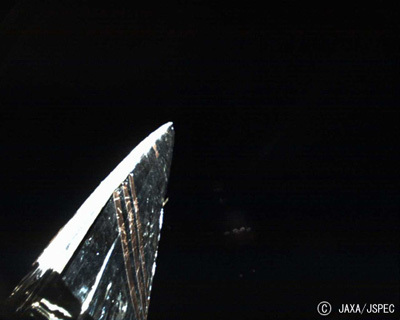
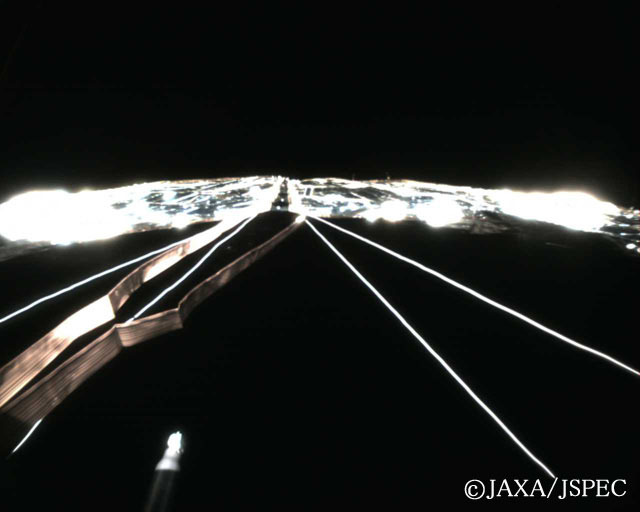
Update: JAXA are now reporting a successful full deployment of the sail, and that the sail's thin-film solar cells are now generating power. It looks like the curse is finally broken.
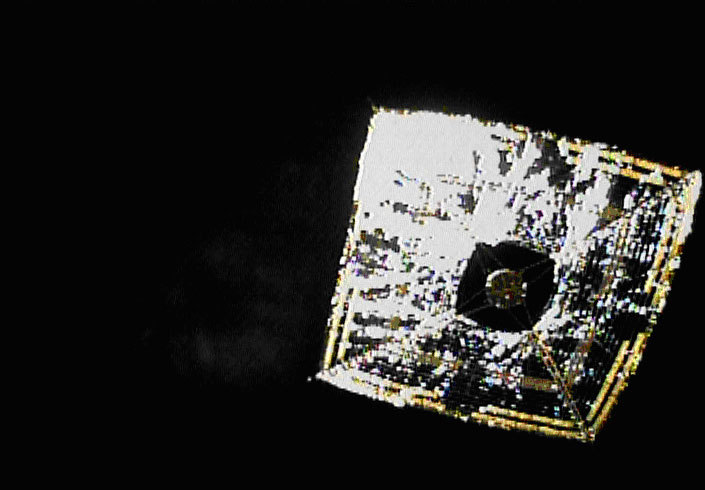
Update: IKAROS has two deployable mini-cameras, these are the first views of the fully deployed sail. Looks good...
In doing so it broke one of the longest running jinxes in spaceflight, it managed to sucessfully put a solar sail spacecraft in orbit. The last time this happened was in 1993 when the Russian Znamya-2 experiment, a spinning sail 60ft in diameter which was sucessfully deployed from a Progress vehicle after undocking from MIR.
The followup experiment in 1999, Znamya-2.5, was a failure after the sail became entangled in a antenna during deployment. The funding crunch that then faced the Russian space programme meant that the ambitious Znamya-3 followup mission, consisting of a 200ft diameter sail deployed from another Progress craft, which was to fly in 2000 or 2001, was unfortunately cancelled.
Around that time the Planetary Society attempted a sub-orbital launch of a prototype solar sail, a flight designed to test a new technology for unfurling solar sail blades, which failed due to a problem with the launch vehicle. The subsequent launch their Cosmos-1 solar sail vehicle in 2005, from a Russian nuclear submarine in the Barents Sea using the same Volna launch vehicle, also failed. Despite their initial optimism, their Cosmos-1 spacecraft did not achieve orbit. Despite this set back, the Planetary Society are still persevering with plans for a fresh mission called Lightsail-1 with a planned launch date around the end of the year.
 |
| CREDIT: NASA |
| NASA's Nanosail-D satellite during deployment testing |
A similar fate to the Planetary Society's Cosmos-1 mission befell NASA's NanoSail-D mission which was lost in a launch failure during the third flight of SpaceX's Falcon 1 rocket in 2008. Despite the sub-orbital tests flown by the Japanese back in 2004, presumably as a pre-cusor to yesterday's IKAROS launch, it seemed that solar-sail mission just couldn't get off the ground.
However, despite the apparent break in the curse associated solar sail missions, the Japanese have yet managed to deploy the sail. The IKAROS spacecraft is currently undergoing in-flight checkout before a scheduled deployment of the sail in a few weeks... fingers crossed.
Update: IKAROS first stage deployment is now halfway complete...
| Credit: JAXA / JSPEC |
| IKAROS first stage deployment halfway complete - A view from one of the four sail monitoring cameras on IKAROS on June 9, 2010 shows the folded sail being pulled outward from the spacecraft as it should be... (via the Planetary Society). |
Update: JAXA are now reporting a successful full deployment of the sail, and that the sail's thin-film solar cells are now generating power. It looks like the curse is finally broken.
| Credit: JAXA / JSPEC |
| Successful sail deployment for IKAROS (via the Planetary Society). |
Update: IKAROS has two deployable mini-cameras, these are the first views of the fully deployed sail. Looks good...
| Credit: JAXA / JSPEC |
| IKAROS sail from DCAM2 - One of the deployable cameras on IKAROS shows the IKAROS solar sail fully deployed. (via the Planetary Society). |
Subscribe to:
Posts (Atom)